
Article
Netherlands To Tax Unrealized Capital Gains
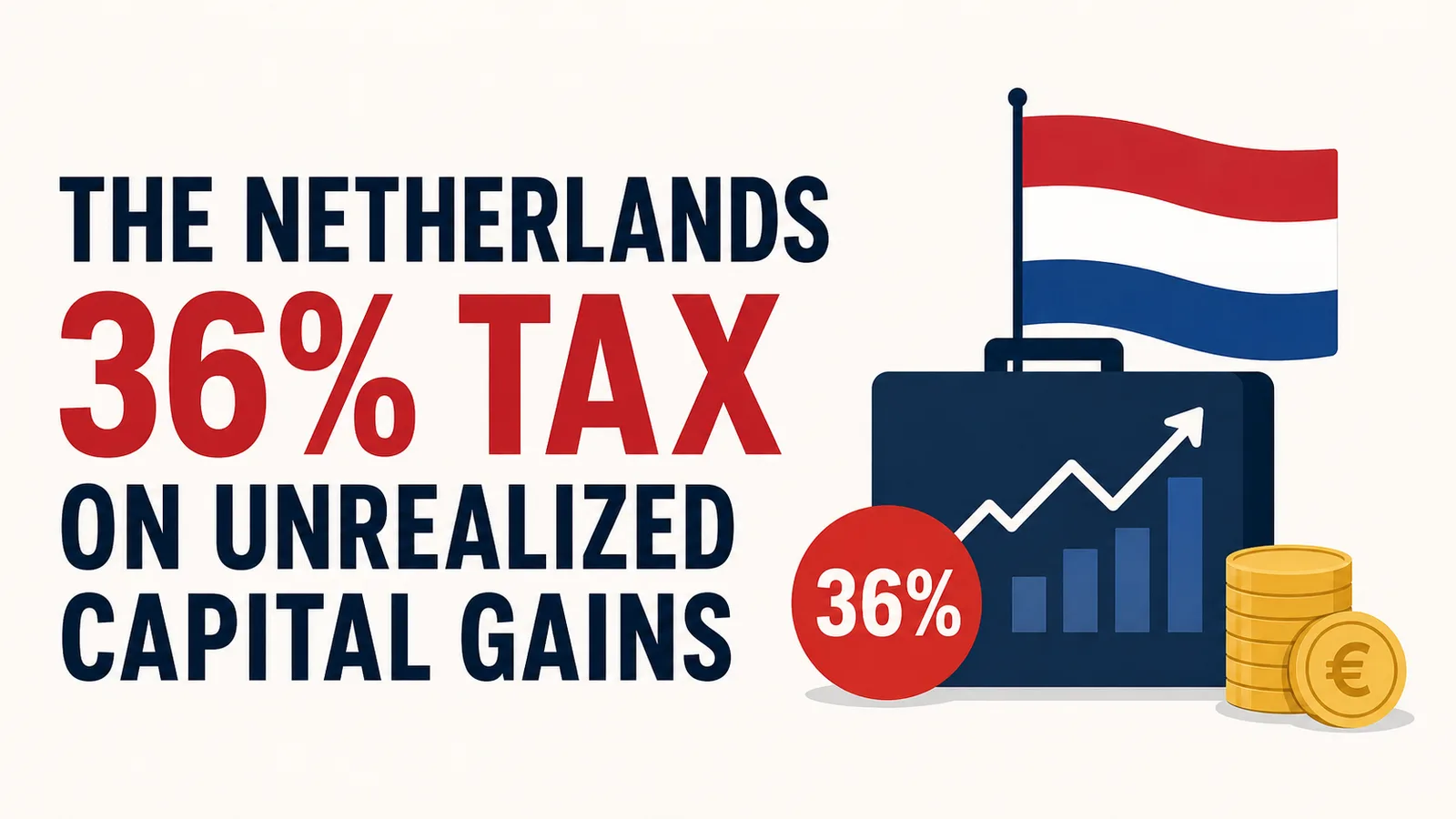
Starting January 1, 2028, the Netherlands will introduce a 36% annual tax on unrealized capital gains, fundamentally changing the economics of long-term investing.
A Fundamental Shift in Investing
Starting January 1, 2028, the Netherlands 🇳🇱 will implement one of the most controversial tax reforms seen in modern European investing policy: a 36% annual tax on unrealized capital gains. In practical terms, this means investors may be required to pay taxes not on profits they actually received, but on gains that exist only on paper at the end of each fiscal year. A portfolio increasing in value becomes a taxable event even if no shares were sold, no cash was withdrawn, and no income was generated.
At first glance, the reform may sound technical or administrative, but its implications are far deeper. For decades, long-term investing has been built around a relatively simple principle: capital compounds over time, and taxes are generally triggered once gains are realized through a sale. The Dutch model challenges that principle directly. Under this framework, merely holding appreciating assets becomes enough to generate a recurring tax obligation. Investors may therefore find themselves forced to liquidate part of their portfolio each year simply to pay taxes on gains that may disappear entirely before the assets are ever sold.
Why This Matters
The origins of the reform trace back to a 2021 ruling by the Dutch Supreme Court, which declared the country’s previous wealth-tax system unconstitutional because it relied on fictional assumed returns rather than actual market performance. The government’s response was to redesign the system around “real” investment gains. On paper, that may appear more rational. In reality, however, the shift introduces a structural problem that disproportionately affects ordinary investors attempting to build wealth through passive long-term exposure to equities.
The mathematics behind the system become particularly alarming once inflation is considered. Imagine an investor earning an 8% nominal annual return during a period of 4.5% inflation. In real purchasing-power terms, the actual gain is closer to roughly 3.3–3.5%. Yet the 36% tax is not applied to the real return. It is applied to the full nominal gain. An 8% increase therefore generates a tax burden equivalent to 2.88% of the portfolio annually, reducing the post-tax nominal return to roughly 5.12%. After adjusting for inflation, the investor is left with approximately 0.6% real growth. In other words, more than 80% of the investor’s real purchasing-power gain is effectively destroyed through taxation.
This is where the debate moves beyond simple tax policy and into questions of economic incentives. Long-term investing functions because compounding is extraordinarily powerful over multi-decade periods. A system that continuously extracts capital from unrealized growth weakens the compounding mechanism itself. The investor is no longer allowed to let capital remain untouched and accumulate naturally over time; instead, the state effectively inserts itself into the compounding process every single year.
Inequality, Exemptions, and Structural Advantages
The reform also raises uncomfortable questions about fairness. Wealthier investors often possess access to legal structures unavailable or impractical for ordinary households. In the Netherlands, high-net-worth individuals can frequently restructure assets into private holding companies such as Dutch BVs, allowing taxation to be deferred or optimized through alternative mechanisms. Retail investors following conventional financial advice — investing monthly into diversified index funds and holding them for decades — do not necessarily have access to those same tools. The result is a system where sophisticated investors may largely avoid the most punitive effects, while smaller investors bear the burden directly.
Even more striking are some of the exemptions and valuation inconsistencies embedded within the broader framework. Certain assets, such as boats, are exempt. Works of art occupy a separate category where no continuously enforced market valuation exists. A painting purchased for €50,000 can potentially be declared at a similar value years later or even marked lower, generating deductible losses despite the underlying asset potentially appreciating significantly in reality. Financial assets, by contrast, are repriced continuously and taxed with precision because market valuations are instantly visible and easily enforceable.
The risks extend beyond individual investors. If large numbers of people are forced to periodically liquidate portions of their portfolios to satisfy annual tax obligations, the effects could compound at the market level as well. A tax structure that systematically incentivizes recurring selling pressure introduces distortions into long-term capital allocation and could amplify volatility during downturns, particularly if declining markets coincide with tax liabilities calculated from prior valuations.
Final Thoughts
What makes this development especially significant is not only the policy itself, but what it signals philosophically. Governments are increasingly searching for ways to tax accumulated wealth more aggressively, particularly in a world where housing, equities, and financial assets have appreciated faster than wages for years. The Netherlands may become a test case for whether unrealized capital gains taxation can be implemented at scale in developed economies without fundamentally damaging retail investing behavior.
I am 19 years old and only recently began thinking seriously about long-term financial planning, investing, and economic freedom. Perhaps that is precisely why this debate feels so important. The idea that the state can tax the growth of your savings before you ever realize those gains changes the psychological relationship people have with investing itself. Whether one supports or opposes the policy, it deserves far more public attention and scrutiny than it is currently receiving.